The gateway your bank probably handed you
MPGS is what many acquiring banks across the Gulf resell under their own name, so merchants often receive credentials with no integration help attached. The API is capable and well documented — and the integration still takes a fortnight to get right, because the interesting parts are the ones that only appear when something goes wrong.
Integration routes
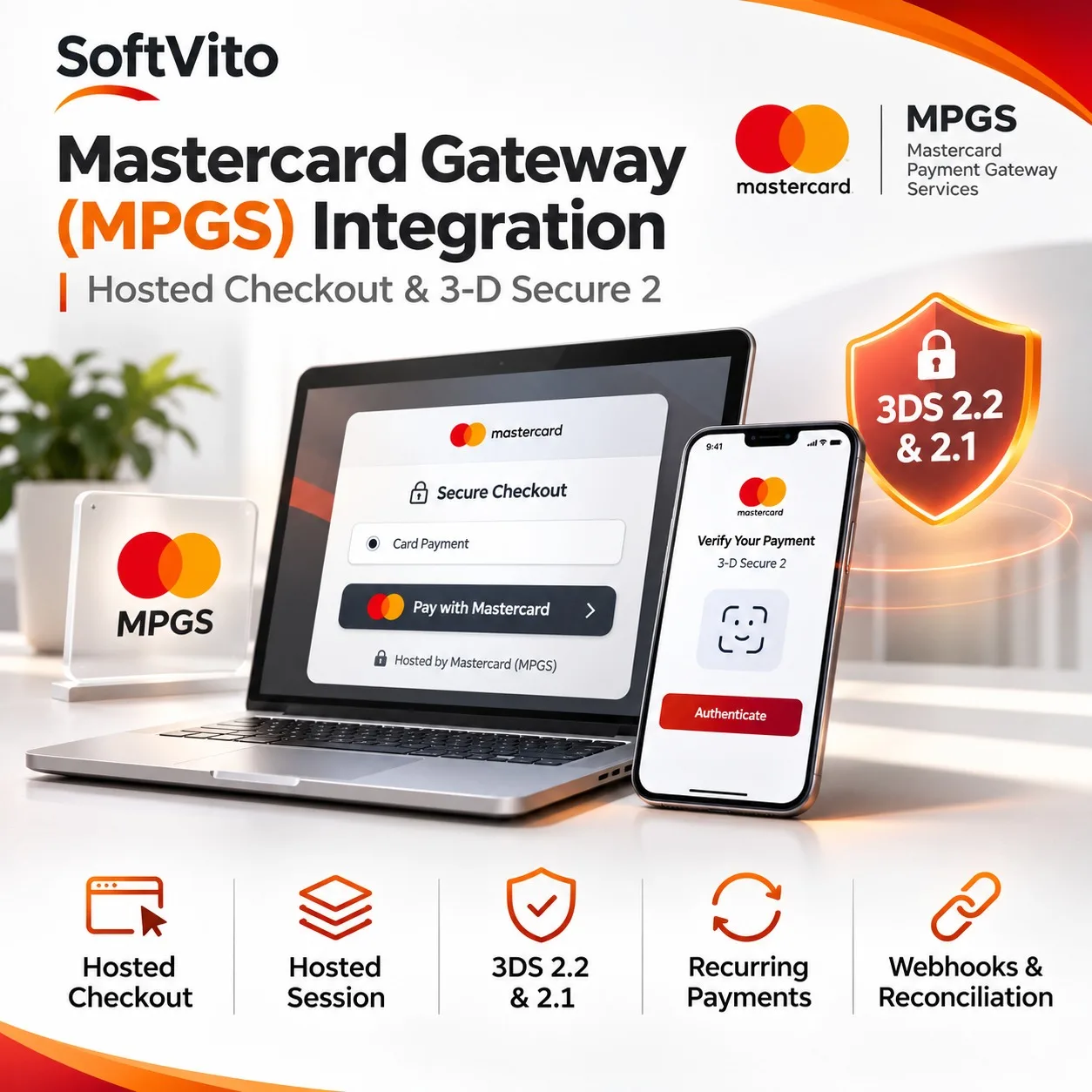
- Hosted Checkout — the fastest path, a Mastercard-hosted payment interaction; cards never touch your infrastructure
- Hosted Session — your own checkout design, with card fields hosted by the gateway so your PCI scope stays at SAQ A
- Direct API where you need full control and hold the scope for it
- Whichever route, one integration covers the cards and methods your acquirer has enabled
3-D Secure, all versions
- 3DS 2.2, 2.1 and legacy 3DS 1 — because acquirers in this region are still enabled for different ones, and a checkout has to handle whichever the issuer answers with
- Frictionless authentication configured so low-risk transactions pass silently instead of pushing every customer to an OTP screen
- Challenge flow implemented as a proper state machine, including the abandoned challenge
- Authentication results recorded against the order for chargeback defence
Tokens and repeat payments
- Gateway tokenisation for stored cards
- Card-on-file and recurring transaction indicators set correctly — get these wrong and issuers decline your renewals, which is a revenue problem that looks like a technical one
- Scheduled payments where your acquirer supports them
Operations, not just checkout
Webhooks and reconciliation. Idempotent handlers with signature verification, plus a scheduled retrieval sweep for transactions that went quiet — the order that completed but never notified you is found and settled automatically.
Captures, voids, refunds and partial refunds exposed to your own admin, with the gateway reference stored on every one so a settlement file can be matched line by line.
Reporting. Transaction retrieval wired up so your finance team can answer "did this one settle?" without logging into a separate portal.
How it runs
- Day 1: review your checkout and confirm what your acquirer has enabled on the merchant profile
- Days 2–6: sandbox integration, every path tested — approved, declined, challenged, abandoned, refunded, timed out
- Day 7: production credentials, a live low-value transaction, refunded on the spot
- Handover: documentation, the test-card reference and a runbook for the failures worth knowing about
Platforms
Laravel · WordPress and WooCommerce · custom PHP · Node.js · .NET · Flutter and React Native · native Android and iOS
Scope note
Covers one platform and one merchant profile. Multiple currencies, several storefronts or a marketplace split are quoted after a short call. The merchant agreement is between you and your acquiring bank.

 Setup